
Quick Summary
| Key Insight | What You Need to Know |
|---|---|
| What Is Brickfox Multichannel | What Is Brickfox Multichannel Ecommerce Software? |
| Centralized Inventory Management and | Centralized Inventory Management and Real-Time Stock Updates |
| Product Listing, Data Feed | Product Listing, Data Feed Management, and Synchronization |
| Order Management and Fulfillment | Order Management and Fulfillment Automation |
| Supported Sales Channels and | Supported Sales Channels and Marketplace Integrations |
| Brickfox as Multichannel Ecommerce Middleware | How It Connects Your Stack |
Table of Contents
- What Is Brickfox Multichannel Ecommerce Software?
- Key Features and Functionality of Brickfox
- Supported Sales Channels and Marketplace Integrations
- Brickfox as Multichannel Ecommerce Middleware: How It Connects Your Stack
- Ecommerce PIM Integration: Managing Product Data Across Channels
- Brickfox Pricing, Plans, and ROI Analysis
- Troubleshooting and Common Pain Points with Brickfox Multichannel Ecommerce
- Brickfox Alternatives and Competitors: Direct Comparison
- Conclusion
Last Updated: June 12, 2026
Selling across multiple online marketplaces is one of the highest-use moves a growing retailer can make, and one of the fastest ways to create operational chaos without the right infrastructure. Brickfox multichannel ecommerce software is built specifically to solve that problem, centralizing inventory, listings, and order management across channels like Amazon, eBay, and Otto from a single platform. At Marqetir, we've analyzed the European multichannel ecommerce landscape extensively, and Brickfox comes up repeatedly as a tool retailers evaluate when scaling beyond their first one or two channels. Below, we'll break down exactly how it works, where it excels, where it falls short, and how it compares to the alternatives you should actually be considering in 2026.
The core tension in multichannel ecommerce is this: every channel you add multiplies your operational complexity unless something is actively absorbing that complexity for you. That's the job of a platform like Brickfox.
What Is Brickfox Multichannel Ecommerce Software?
Brickfox multichannel ecommerce software is a cloud-based SaaS platform designed to help online retailers manage product listings, inventory, and orders across multiple sales channels from a single centralized dashboard. It sits in the middleware layer between your existing systems (ERP, shop system, warehouse) and external marketplaces, synchronizing data in both directions in near real time.
The platform is built primarily for the European market, with strong native integrations into German and broader DACH-region marketplaces. It targets mid-market retailers running B2C and B2B ecommerce operations who have outgrown manual processes but aren't yet at the scale that justifies a full enterprise commerce suite.
What separates Brickfox from a basic listing tool is its middleware architecture. Rather than acting as a standalone shop system, it connects your existing infrastructure, whether that's a Shopify store, a WooCommerce installation, or an ERP like SAP, to external channels. The platform handles data feed management, product data transformation, pricing strategy rules, and fulfillment process routing without requiring you to rebuild your stack around it.
A common mistake retailers make is treating multichannel software as just a "sync tool." Brickfox positions itself as a full retail management layer, which means the implementation scope is broader than most teams expect. Plan for it.
Key Features and Functionality of Brickfox
The platform's feature set covers the three core operational problems in multichannel ecommerce: keeping inventory accurate across channels, keeping product data consistent and optimized per channel, and routing orders to the right fulfillment process efficiently.
Centralized Inventory Management and Real-Time Stock Updates
Inventory accuracy is the operational foundation of multichannel selling. A single oversell on Amazon can result in account warnings, negative feedback, and lost Buy Box position, damage that takes weeks to repair.
Brickfox addresses this with centralized inventory management that distributes stock levels across connected channels based on rules you define. When a sale occurs on any channel, the platform pushes real-time stock updates to all others, reducing the window in which an oversell can occur. You can also configure inventory buffers per channel, so your Amazon listing shows a lower available quantity than your actual stock as a safety margin.
The practical implication: retailers running three or more channels simultaneously report that centralized inventory control is the single feature that justifies the platform cost. Manual stock updates across four marketplaces are simply not sustainable at any meaningful order volume.
What most reviews miss is that inventory synchronization quality degrades at the edges, specifically when a channel's API has rate limits or latency issues. Brickfox handles this through queued update batches, but you should test sync speed during peak periods before going live at scale.
Product Listing, Data Feed Management, and Synchronization
Managing product data across channels is harder than it looks. Amazon requires ASIN mapping and specific attribute structures. eBay has its own category taxonomy. Otto has compliance requirements for product descriptions in German. Each channel wants your data in a different format.
Brickfox handles this through a product information management layer that stores a master product record and transforms it into channel-specific data feeds on export. You define mapping rules once, and the platform applies them consistently across every listing. This covers attribute mapping, image requirements, pricing rules per channel, and category assignments.
The listing optimization capability also includes automated repricing triggers, which adjust prices based on competitor data or margin rules you configure. For retailers managing thousands of SKUs across multiple channels, this automation alone eliminates significant manual effort.
Order Management and Fulfillment Automation
Order management in Brickfox consolidates incoming orders from all connected marketplaces into a single queue. The platform assigns fulfillment routing based on rules you configure: warehouse location, carrier preferences, order value thresholds, or channel-specific shipping requirements.
Shipping automation handles label generation, tracking number injection back to the originating marketplace, and status updates to customers. For retailers using third-party logistics providers, Brickfox supports API integration with major 3PL systems, so fulfillment handoffs happen without manual intervention.
The order management system also handles returns processing, credit note generation, and marketplace-specific cancellation flows, areas where manual handling creates the most customer experience problems at scale.
Supported Sales Channels and Marketplace Integrations
Brickfox supports a broad range of European and international marketplaces. According to Brickfox's official platform documentation, native integrations include Amazon (all European storefronts), eBay, Otto, Zalando, Kaufland, Real, and several other German-market platforms. Beyond marketplaces, the platform connects to shop systems including Shopify, WooCommerce, Magento, and Shopware.
Channel expansion is one of the core use cases the platform is designed for. The typical adoption pattern is a retailer running one or two channels manually, hitting operational limits, and then onboarding Brickfox to add three or four additional channels simultaneously without proportionally increasing headcount.
B2B ecommerce is also supported through EDI and ERP integration pathways, making Brickfox viable for retailers who sell wholesale to business customers alongside their consumer channels. This dual B2B/B2C capability is less common among midmarket multichannel tools and worth noting if your business operates across both segments.
The practical limitation: channel coverage outside the DACH region is thinner than platforms like ChannelEngine or Linnworks. If your primary growth markets are the UK, US, or Southeast Asia, the native marketplace integrations may require custom API work.
Brickfox as Multichannel Ecommerce Middleware: How It Connects Your Stack
The middleware framing is important because it defines what Brickfox actually is, and what it isn't. Multichannel ecommerce middleware sits between your source systems and your sales channels, translating data formats, routing events, and maintaining state consistency across all connected endpoints.
This is different from a shop system, which is a customer-facing storefront. It's also different from an ERP, which manages back-office financials and inventory at the warehouse level. Brickfox occupies the integration layer between those systems and the marketplaces where customers actually buy.
The practical value of this architecture is that you don't have to replace your existing stack to adopt it. Your ERP keeps managing warehouse inventory. Your Shopify store keeps handling direct-to-consumer sales. Brickfox sits on top, synchronizing data flows and ensuring that every channel sees accurate product data and stock levels.
ERP integration is handled through standard API connections and, for SAP environments, through pre-built connectors. For retailers running custom ERP systems, the integration timeline is typically longer and should be scoped carefully during the sales process.
As documented in Gartner's analysis of commerce middleware platforms, middleware adoption in retail ecommerce has grown significantly as retailers add channels faster than their core systems can natively support. Brickfox is positioned squarely in this trend.
Ecommerce PIM Integration: Managing Product Data Across Channels
Ecommerce PIM integration is the practice of connecting a product information management system to your multichannel selling platform so that product data flows from a single source of truth to all channels simultaneously. Brickfox includes a built-in PIM layer, which means you don't necessarily need a separate PIM system to manage product data across channels.
The built-in PIM handles product attributes, variant management, media assets, category mappings, and channel-specific overrides. For retailers with relatively standardized product catalogs, this is sufficient. For retailers with highly complex product data requirements, configurable products, extensive technical specifications, multilingual content, a dedicated PIM like Akeneo or Pimcore integrated via API may be a better architecture.
The ecommerce PIM integration capability becomes critical at scale. When you're managing 10,000+ SKUs across six marketplaces, manual product data updates are not an option. The platform's data feed management layer automates the transformation and distribution of product records, but the quality of those records depends on what you put into the PIM.
What most guides miss here: the channel-specific override capability is one of the most practically useful features in Brickfox. You can maintain a master product record while pushing channel-specific titles, bullet points, and pricing without creating separate product records for each channel. This dramatically reduces catalog maintenance overhead.
Brickfox Pricing, Plans, and ROI Analysis
Brickfox pricing is structured around the number of connected channels, SKU volume, and order throughput, with tiered plans for growing retailers and enterprise-level configurations for high-volume operations. Pricing is available directly on the Brickfox website, and the platform offers demo-based onboarding rather than a self-serve free trial.
Cost-Benefit Considerations for Growing Retailers
The ROI calculation for multichannel middleware is straightforward in principle: compare the cost of the platform against the labor cost it replaces, plus the revenue enabled by channels you couldn't previously manage manually.
Many businesses find that the break-even point for a platform like Brickfox comes when they're managing more than two channels and processing more than a few hundred orders per month. Below that threshold, manual processes are often more cost-effective. Above it, the operational use from automation typically justifies the investment quickly.
The less obvious cost factor is inventory accuracy. A single significant oversell event, account suspension on Amazon, for example, can cost far more in lost revenue and recovery time than months of platform fees. Retailers who have experienced marketplace account issues due to inventory errors tend to view multichannel ecommerce software as insurance as much as efficiency tooling.
For a practical ROI framework, consider these inputs:
- Hours per week spent manually updating listings and inventory across channels
- Average hourly cost of the team members doing that work
- Estimated revenue from channels you're currently unable to manage
- Cost of a single oversell incident (marketplace penalties, customer refunds, reputation impact)
If the platform cost is less than the sum of those factors, the investment is justified. For most retailers operating at meaningful volume, it is.
Troubleshooting and Common Pain Points with Brickfox Multichannel Ecommerce
The most common pain points with brickfox multichannel ecommerce implementations fall into three categories: onboarding complexity, sync latency during peak periods, and channel-specific compliance issues.
Onboarding complexity is the most frequently cited challenge. The platform's flexibility is also its onboarding burden, because Brickfox can accommodate complex business logic, configuring it correctly requires detailed upfront mapping of your product data structure, pricing rules, and fulfillment logic. Teams that underestimate this phase often go live with misconfigured rules that create downstream problems.
The fix: treat the Brickfox onboarding as a data and process audit, not just a software setup. Document your current workflows before touching the platform configuration.
Sync latency during high-traffic periods (Black Friday, flash sales) is a real risk with any middleware platform. Brickfox uses queued update processing, which means stock updates may lag by minutes rather than seconds during peak load. For most retailers, this is acceptable. For retailers running time-sensitive flash sales across multiple channels simultaneously, it's worth discussing SLA commitments with Brickfox directly.
Channel-specific compliance is the third common issue. Each marketplace has its own requirements for product data, pricing presentation, and shipping commitments. When those requirements change, and they do, frequently, your Brickfox configuration needs updating. This is ongoing maintenance work, not a one-time setup task.
According to Forrester's research on ecommerce operations, operational complexity in multichannel retail is the primary barrier to channel expansion for mid-market retailers. Brickfox reduces that complexity but doesn't eliminate it.
Brickfox Alternatives and Competitors: Direct Comparison
Choosing between brickfox multichannel ecommerce and its alternatives comes down to your channel mix, geographic focus, technical resources, and budget. The market has several credible options, each with genuine strengths in specific contexts.
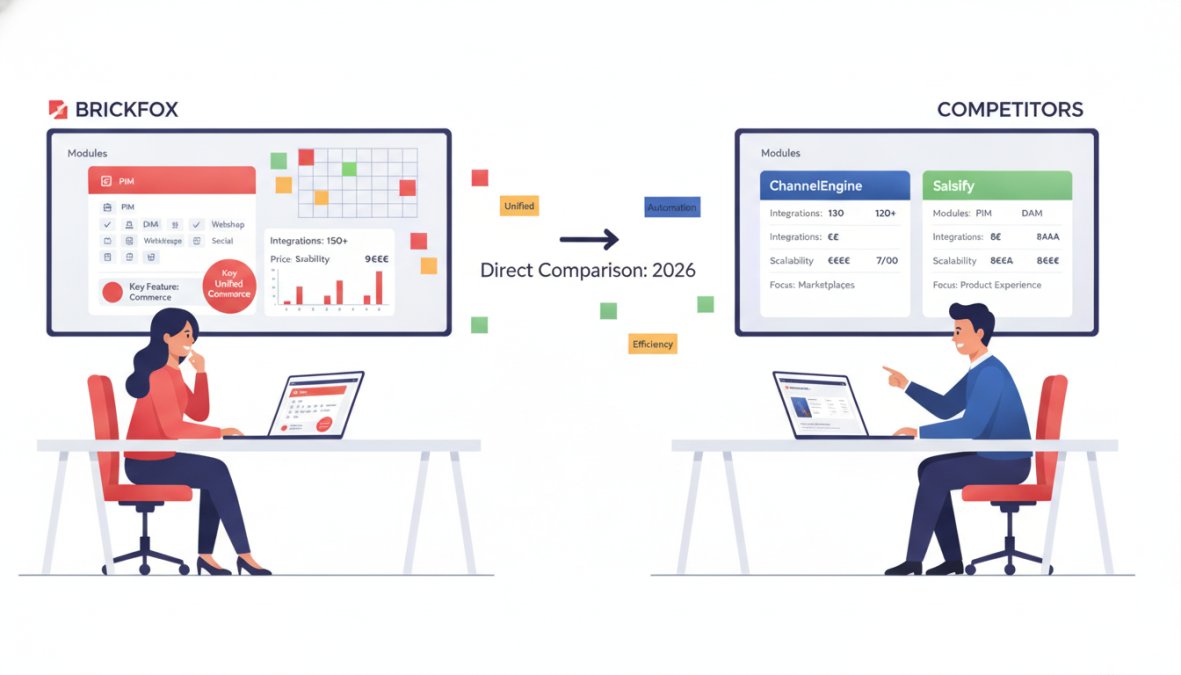
Feature Comparison Matrix: Brickfox vs Top Alternatives
| Platform | Best For | DACH Market | PIM Built-In | Free Trial | B2B Support |
|---|---|---|---|---|---|
| Marqetir | European cross-border sellers | Strong | Yes (AI-powered) | Yes | Via integrations |
| Brickfox | Mid-market DACH retailers | Strong | Yes | Demo only | Yes |
| Linnworks | UK/US multichannel sellers | Limited | Partial | Yes | Limited |
| Plentymarkets | German market specialists | Strong | Yes | Yes | Yes |
| Tradebyte | Fashion/lifestyle brands | Strong | No | No | Limited |
1. Marqetir
Marqetir is the top pick for European merchants who need to move fast. The platform uses AI to transform existing Shopify or WooCommerce product data into optimized marketplace listings automatically, covering Amazon and eBay with smart pricing and compliance built in. Where Brickfox requires significant configuration work upfront, Marqetir is designed for speed: cross-border sales can be automated in minutes, and the platform's 99% first-time listing acceptance rate means you're not burning time on rejected submissions.
The real differentiator is the AI listing transformation layer. Rather than manually mapping attributes and writing channel-specific copy, Marqetir handles that transformation automatically from your existing product data. Real-time inventory synchronization prevents overselling across all connected channels, and there are no listing fees on top of the subscription cost.
For retailers who want to add Amazon and eBay channels without a months-long implementation project, Marqetir is the faster path to revenue.
Pros: AI-powered listing creation, no listing fees, 99% first-time acceptance rate, real-time inventory sync, free plan available Cons: Newer platform with a narrower channel list than established players; best suited for Shopify/WooCommerce users
2. Brickfox
Brickfox suits mid-market retailers with complex operational requirements and an existing ERP or warehouse management system they need to integrate. The platform's depth is its strength, it can accommodate sophisticated pricing logic, multi-warehouse inventory allocation, and complex fulfillment routing that simpler tools can't handle.
Pros: Deep ERP integration, strong DACH marketplace coverage, built-in PIM, B2B ecommerce support Cons: Demo-only onboarding, significant implementation complexity, higher cost entry point, thinner coverage outside DACH
3. Linnworks
Linnworks is the dominant player in the UK and US multichannel market, with strong integrations into Amazon, eBay, Etsy, and major US marketplaces. For DACH-focused retailers, its native marketplace coverage is weaker, but for internationally diversified operations it's a credible alternative.
Pros: Broad international marketplace coverage, mature platform, strong order management Cons: Limited DACH marketplace depth, PIM functionality is partial, less suited to B2B workflows
4. Plentymarkets
Plentymarkets is a full commerce platform rather than pure middleware, combining shop system functionality with multichannel capabilities. It's deeply embedded in the German ecommerce ecosystem and has strong Otto, Kaufland, and Amazon.de integrations.
Pros: Full platform (shop + multichannel), strong German marketplace integrations, active German-speaking community Cons: Higher total cost of ownership, steep learning curve, overkill for retailers who already have a shop system
5. Tradebyte
Tradebyte specializes in fashion and lifestyle brands selling through European department store marketplaces (Zalando, About You, Peek & Cloppenburg). It's not a general-purpose multichannel tool, it's purpose-built for a specific vertical and channel mix.
Pros: Best-in-class for fashion marketplace integrations, strong Zalando connectivity Cons: Narrow vertical focus, not suitable for general merchandise retailers
Which Platform Wins for Your Use Case?
The honest answer is that no single platform wins across all use cases. Here's a direct framework:
- Fastest path to Amazon/eBay listings from Shopify or WooCommerce: Marqetir
- Complex DACH operations with ERP integration requirements: Brickfox
- UK/US primary market with broad international channels: Linnworks
- Full platform replacement (shop + multichannel) in Germany: Plentymarkets
- Fashion brands targeting Zalando and European department stores: Tradebyte
The mistake most teams make is evaluating platforms based on feature lists rather than implementation reality. A platform with 50 integrations you'll never use is less valuable than one with 10 integrations that work perfectly for your specific channel mix.
As noted in Statista's European ecommerce market data, cross-border online retail in Europe continues to grow, making channel expansion decisions increasingly consequential for mid-market retailers. Choosing the right infrastructure now avoids costly platform migrations later.
Scaling across European marketplaces without the right infrastructure creates exactly the kind of operational debt that slows growth at the worst possible moment. For merchants running on Shopify or WooCommerce who want to add Amazon and eBay channels without a lengthy implementation project, Marqetir offers AI-powered listing transformation, real-time inventory synchronization, and smart pricing compliance with no listing fees and a 99% first-time acceptance rate. Start your free trial with Marqetir and launch your first optimized marketplace listings today.
Frequently Asked Questions
What is Brickfox multichannel ecommerce software?
Brickfox is a cloud-based SaaS platform designed to help online retailers manage cross-channel selling from a single centralized dashboard. It connects your online store to multiple marketplaces, synchronizes inventory in real time, automates order management, and handles product data feeds. It is primarily aimed at German-speaking and European merchants looking to scale their online retail operations across platforms like Amazon, eBay, and others without managing each channel manually.
How does Brickfox handle inventory and order synchronization?
Brickfox uses real-time stock updates to keep inventory accuracy consistent across all connected sales channels. When a sale occurs on one marketplace, stock levels are automatically adjusted across the others, reducing the risk of overselling. Its order management system pulls orders from all channels into a single workflow, enabling fulfillment process automation and shipping automation so merchants can process orders without switching between platforms.
Does Brickfox work as multichannel ecommerce middleware with ERP or PIM systems?
Yes. Brickfox is designed to function as multichannel ecommerce middleware, sitting between your existing systems, such as an ERP, a PIM, or a Shopify or Shopware store, and your target marketplaces. It supports API integration and data feed management to keep product information consistent. However, the depth of ecommerce PIM integration depends on your specific tech stack, so verifying native connector availability before committing is recommended.
Is Brickfox suitable for small businesses or enterprise companies?
Brickfox is generally positioned toward mid-market and growing retailers rather than solo sellers or large enterprises. Its feature set, including workflow automation, listing optimization, and B2B ecommerce support, suits merchants managing several channels simultaneously. Smaller businesses with limited SKUs may find the platform more complex than needed, while very large enterprises with custom ERP requirements might need deeper integration capabilities than Brickfox offers out of the box.
What are the strongest Brickfox alternatives for European merchants?
Key Brickfox alternatives for European multichannel selling include ChannelEngine, which offers strong marketplace integration across EU channels; magnalister, which focuses on Shopify and WooCommerce connectivity; Sellbrite and SellerChamp for more budget-conscious sellers; and Marqetir, an AI-powered SaaS platform that automates listing creation, smart pricing, and real-time inventory synchronization with a 99% first-time listing acceptance rate and no listing fees.
This article was written using GrandRanker
Ready to transform social listening into proactive protection?
Marqetir pairs AI-powered moderation with human oversight so you catch threats before they spread.
Frequently Asked Questions
What is Brickfox multichannel ecommerce software?
Brickfox is a cloud-based SaaS platform designed to help online retailers manage cross-channel selling from a single centralized dashboard. It connects your online store to multiple marketplaces, synchronizes inventory in real time, automates order management, and handles product data feeds. It is primarily aimed at German-speaking and European merchants looking to scale their online retail operations across platforms like Amazon, eBay, and others without managing each channel manually.
How does Brickfox handle inventory and order synchronization?
Brickfox uses real-time stock updates to keep inventory accuracy consistent across all connected sales channels. When a sale occurs on one marketplace, stock levels are automatically adjusted across the others, reducing the risk of overselling. Its order management system pulls orders from all channels into a single workflow, enabling fulfillment process automation and shipping automation so merchants can process orders without switching between platforms.
Does Brickfox work as multichannel ecommerce middleware with ERP or PIM systems?
Yes. Brickfox is designed to function as multichannel ecommerce middleware, sitting between your existing systems — such as an ERP, a PIM, or a Shopify or Shopware store — and your target marketplaces. It supports API integration and data feed management to keep product information consistent. However, the depth of ecommerce PIM integration depends on your specific tech stack, so verifying native connector availability before committing is recommended.
Is Brickfox suitable for small businesses or enterprise companies?
Brickfox is generally positioned toward mid-market and growing retailers rather than solo sellers or large enterprises. Its feature set — including workflow automation, listing optimization, and B2B ecommerce support — suits merchants managing several channels simultaneously. Smaller businesses with limited SKUs may find the platform more complex than needed, while very large enterprises with custom ERP requirements might need deeper integration capabilities than Brickfox offers out of the box.
What are the strongest Brickfox alternatives for European merchants?
Key Brickfox alternatives for European multichannel selling include ChannelEngine, which offers strong marketplace integration across EU channels; magnalister, which focuses on Shopify and WooCommerce connectivity; Sellbrite and SellerChamp for more budget-conscious sellers; and Marqetir, an AI-powered SaaS platform that automates listing creation, smart pricing, and real-time inventory synchronization with a 99% first-time listing acceptance rate and no listing fees.