
Quick Summary
| Key Insight | What You Need to Know |
|---|---|
| Why Inventory Synchronization Risks | Why Inventory Synchronization Risks Are a Growing Threat in 2026 |
| How Inventory Sync Works Across Multichannel Ecommerce The Role of a Central Database in Data Consistency WMS and ERP Integration | Where Sync Breaks Down |
| The Role of a | The Role of a Central Database in Data Consistency |
| WMS and ERP Integration | Where Sync Breaks Down |
| Common Inventory Discrepancy Causes | Common Inventory Discrepancy Causes You Need to Know API Rate Limits and Latency as Hidden Sync Killers |
| API Rate Limits and | API Rate Limits and Latency as Hidden Sync Killers |
Table of Contents
- Why Inventory Synchronization Risks Are a Growing Threat in 2026
- How Inventory Sync Works Across Multichannel Ecommerce
- Common Inventory Discrepancy Causes You Need to Know
- The Financial Impact of Inventory Synchronization Risks
- Multichannel Inventory Management Challenges Merchants Face
- Ecommerce Overselling Prevention: A Step-by-Step Framework
- API Failure Recovery Protocols for Inventory Nodes
- How Automated Inventory Software Eliminates Manual Errors
- Conclusion
Last Updated: June 11, 2026
Inventory synchronization risks are quietly one of the most expensive operational problems in multichannel ecommerce, and most merchants don't realize how exposed they are until a high-value order fails. At Marqetir, we track these failure patterns across European merchants selling on Amazon, eBay, and beyond: sync gaps compound fast, and the financial damage follows. Below, we'll show you exactly how sync failures happen, where they hit hardest, and how to build a framework that prevents them before they escalate.
The core problem is deceptively simple. Your inventory exists across multiple nodes simultaneously, and every channel expects an accurate count. When those counts diverge, even briefly, the consequences cascade: overselling, failed fulfillment, customer dissatisfaction, and marketplace penalties.
Why Inventory Synchronization Risks Are a Growing Threat in 2026
Merchants who once sold through a single Shopify store now manage listings across Amazon, eBay, regional marketplaces, and their own webstore simultaneously. Each additional channel multiplies the surface area for inventory synchronization risks.
Every sales channel operates on its own clock. A purchase on Amazon doesn't automatically update your WooCommerce stock unless a properly configured integration handles that handoff. When sync frequency is too low or API calls fail silently, stock levels drift, and that drift is where overselling lives.
What makes 2026 particularly challenging is accelerating buyer expectations. Same-day and next-day fulfillment commitments mean merchants have less buffer time to catch discrepancies. A stock mismatch that once caused a minor delay now triggers cancellations, negative reviews, and marketplace account restrictions. SKU proliferation compounds this: manual processes that worked at 200 SKUs collapse at 2,000.
According to Gartner's supply chain technology research, inventory accuracy is one of the top operational priorities for retail technology investment, and the gap between leaders and laggards is widening as automation becomes standard.
How Inventory Sync Works Across Multichannel Ecommerce
Inventory synchronization is the automated process of propagating stock level changes across all connected sales channels and fulfillment systems in real time or near-real time. When a unit sells on one platform, the system decrements that count and pushes the updated figure to every other connected channel before the next order can be placed.
The mechanics involve several layers. At the top sits your source of truth, typically a central database or primary ecommerce platform. Below that, middleware or direct API integrations connect each sales channel. Every transaction triggers an event, that event calls the API, and the API updates the downstream channel's inventory record. In theory, this is clean. In practice, it's fragile at every seam.
The Role of a Central Database in Data Consistency
Data consistency across channels depends entirely on a single authoritative inventory record. Without a central database acting as the master stock ledger, each channel maintains its own inventory book, and those books inevitably diverge.
Every channel reads from and writes to the central database. When a sale occurs on eBay, the event writes a decrement to the central record, which then propagates outward to Amazon, your webstore, and any other connected platform. The sequence matters: write to center first, then push outward. Channels that write to their own local records first and sync later create race conditions where two simultaneous orders can both succeed against the same available stock. Many operations teams run reconciliation checks every 15 minutes during peak hours and hourly during off-peak periods.
WMS and ERP Integration: Where Sync Breaks Down
The integration between a Warehouse Management System (WMS) and an Enterprise Resource Planning (ERP) system is where inventory synchronization risks concentrate most heavily in mid-market operations. A WMS tracks physical stock; an ERP tracks financial and operational records. When these don't communicate in real time, the numbers diverge, the ERP might show 500 units available while the WMS knows 80 are already allocated to pending orders.
Common breakdown points include:
- Batch sync intervals: Many WMS/ERP integrations run on scheduled jobs rather than event-driven triggers, creating windows where data is stale
- Mapping mismatches: SKU identifiers that don't align between systems cause records to fail silently
- Manual overrides: Warehouse staff adjusting stock counts directly in the WMS without triggering an ERP sync
- Failed transactions: Network interruptions that cause sync calls to drop without retry logic
Common Inventory Discrepancy Causes You Need to Know
Inventory discrepancy causes fall into three broad categories: system failures, process failures, and data failures. System failures include API timeouts, rate limit exhaustion, and integration outages, detectable through monitoring and addressable through technical remediation. Process failures include manual stock adjustments that bypass the sync layer and returns processed outside the standard workflow. Data failures include SKU mapping errors, unit-of-measure mismatches, and duplicate product records that split inventory counts.
The most insidious discrepancies come from combinations: a process failure that creates a data error that then gets propagated by the sync system to every channel simultaneously. By the time the error is visible, it's everywhere.
API Rate Limits and Latency as Hidden Sync Killers
API rate limits are one of the most underappreciated inventory synchronization risks in multichannel ecommerce. Every major marketplace imposes limits on how many API calls your integration can make per second or per hour. When your sync system hits those limits, updates queue, and queued updates mean stale data and stock mismatches.
Latency compounds the problem. Even when API calls succeed, the round-trip time introduces a window where your local record and the channel's record are temporarily out of sync. For high-demand SKUs during a flash sale, that window is enough to generate overselling incidents.
Practical mitigation requires designing your sync architecture with rate limits as a first-class constraint:
- Audit your current API call volume against each platform's documented limits
- Implement exponential backoff and retry logic for failed calls
- Prioritize sync updates for high-velocity SKUs over slow-moving inventory
- Use webhook-based event triggers where platforms support them, reducing polling overhead
- Monitor API response times as a leading indicator of sync degradation
As documented in Amazon's Selling Partner API documentation, rate limits vary by API section and can change with platform updates, making ongoing monitoring essential.
The Financial Impact of Inventory Synchronization Risks
Most articles on inventory synchronization risks describe what goes wrong but never build the financial model showing what it actually costs. Merchants who can't quantify the damage have no basis for justifying investment in better infrastructure.
The True Cost Stack of a Single Oversell Incident
A single oversold order produces a cost stack that compounds across at least five layers, and most merchants only account for the first one.
Layer 1, Direct refund cost. You collected payment and cannot fulfill. The actual cash-flow impact is larger than the order value because payment processors typically do not return transaction fees on refunds.
Layer 2, Customer acquisition cost (CAC) destruction. Every acquired customer carries a CAC. When an oversell forces a cancellation, that CAC is permanently destroyed, the customer churned because your operations failed them. Re-acquiring them requires spending the full CAC again.
Layer 3, Marketplace account health penalties. Amazon, eBay, and most major marketplaces track cancellation rates and order defect rates. Sync failures that drive cancellations push these metrics toward penalty thresholds. The consequences are non-linear: a small increase in cancellation rate can trigger suppressed listing visibility or Buy Box loss across your entire catalog, not just the SKU that caused the incident.
Layer 4, Exception handling labor cost. Every stock discrepancy requires human intervention: investigate the source, correct the central record, notify the customer, process the refund, update the channel listing. Across a month with multiple sync failures, this exception-handling burden becomes measurable operational overhead.
Layer 5, Emergency fulfillment costs. When a merchant chooses to fulfill an oversold order to protect account health, the cost of sourcing inventory urgently or expediting shipping typically exceeds the original order margin. The attempt to recover from a sync failure often costs more than accepting the cancellation.
The Compounding Effect During Peak Periods
The more dangerous financial scenario is a cluster of incidents during a high-velocity period. During peak traffic, API rate limits are hit more frequently, sync latency increases under platform load, and the probability of simultaneous orders against the same available stock rises sharply. Ten oversell incidents in a single day means the full cost stack multiplied by ten, plus account health consequences that accumulate from the spike in cancellation rate.
Quantifying the ROI of Sync Infrastructure Investment
Inventory synchronization infrastructure is not an operational expense, it is a revenue protection investment. The relevant comparison is the cost of better tooling versus the expected value of prevented incidents.
A useful framework:
- Estimate your current incident rate. How many oversell incidents or sync-related cancellations occur per month? Your order management system's cancellation reason codes are the starting point.
- Estimate your average cost per incident. Use the five-layer cost stack above. Even a conservative estimate covering refund fees, CAC destruction, and one hour of exception-handling labor produces a meaningful per-incident cost.
- Estimate the incident reduction from improved sync. Moving from batch sync to real-time event-driven integration, combined with inventory buffers and proper API failure recovery, eliminates the majority of sync-latency-driven oversells.
- Compare the annualized prevented-incident value against the infrastructure cost. For most mid-market multichannel merchants, this comparison strongly favors investment in proper sync architecture.
Multichannel Inventory Management Challenges Merchants Face
Multichannel inventory management challenges scale non-linearly with channel count. Adding a third sales channel doesn't create three times the complexity, it creates something closer to nine times, because every channel must stay synchronized with every other through the central record, and every platform imposes its own constraints on how that synchronization can be implemented.
The most frequent practical challenges include:
Order orchestration conflicts: Two channels receive simultaneous orders for the last available unit. Both succeed because the sync hasn't propagated yet. This is a predictable outcome of any architecture where sync latency exceeds zero and sales velocity is non-trivial.
Return reconciliation lag: A return processed on one channel takes hours or days to reflect in the central record, preventing prompt resale and creating phantom stock discrepancies across all channels.
Seasonal velocity spikes: Sync architectures that perform adequately at normal volumes fail under peak load because API call volumes exceed rate limits and marketplace infrastructure is under stress. The failure mode is silent, calls queue rather than error.
Cross-border inventory allocation: Merchants selling across multiple country-specific marketplace instances must manage allocation decisions that affect sync behavior differently in each market, particularly where fulfillment centers are geographically separated.
Vendor-Specific Sync Limitations Across Major Marketplaces
The specific API constraints of each major platform are the primary determinant of what sync architecture is actually achievable, and where residual risk lives after you've done everything else correctly.
Amazon Selling Partner API (SP-API)
Amazon's inventory update endpoints operate under a dynamic rate limit model that scales based on your account's historical sales velocity, meaning new and growing accounts face tighter constraints precisely when sales volume is increasing fastest. Amazon also maintains a hard architectural separation between FBA and FBM inventory pools, which don't share a sync layer. A merchant running a hybrid fulfillment model must maintain two separate inventory sync pipelines with different latency profiles. Amazon's Near Real-Time inventory updates, available through the Feeds API, offer faster propagation than standard inventory updates but require a different integration pattern that many merchants are unaware of, defaulting to the slower standard path unnecessarily.
eBay Inventory API
eBay's architecture distinguishes between the legacy Trading API and the newer Inventory API, and many third-party integrations still use the Trading API. The Inventory API uses a location-based inventory model where stock is assigned to specific inventory locations before being offered for sale, reducing some race conditions but requiring more complex setup. eBay's Good 'Til Cancelled listing model means quantity updates must be pushed explicitly; there is no automatic decrement mechanism mirroring Amazon's order-acknowledgment flow. Integrations that don't account for this end up with listings reflecting pre-sale quantities until the next scheduled sync cycle.
According to eBay Developer Program API documentation, inventory location and quantity management APIs have specific constraints around bulk update frequency that differ meaningfully from standard listing update endpoints, easy to miss during initial integration and expensive to discover during a peak sales event.
Walmart Marketplace API
Walmart uses a feed-based inventory update model where quantity changes are submitted as batch feeds rather than individual real-time calls. Feed processing is asynchronous, you submit the feed, receive a feed ID, and must poll a separate endpoint to confirm processing status. This introduces an inherent latency floor that cannot be reduced regardless of how fast your integration submits updates. Merchants accustomed to Amazon's near-real-time acknowledgment must adopt a different mental model for what "real-time sync" means on Walmart.
Regional European Marketplaces
Regional marketplaces across Germany, France, the Netherlands, and other European markets often have less mature API infrastructure. Common characteristics include longer minimum sync intervals enforced at the platform level, less reliable webhook delivery requiring fallback polling logic, less comprehensive error response documentation, and slower support response times. These platforms frequently require platform-specific handling logic rather than a generic integration pattern, an operational overhead merchants consistently underestimate when evaluating channel expansion.
Designing for Platform Heterogeneity
A single generic sync architecture cannot be optimally configured for all platforms simultaneously. A well-designed multichannel inventory system treats each platform's constraints as first-class inputs to the integration design. This means maintaining platform-specific sync queues with platform-appropriate retry logic, monitoring rate limit consumption per platform independently, and setting inventory buffer levels that account for each platform's specific latency floor. A buffer sized for Amazon's near-real-time updates will be undersized for Walmart's feed-based processing model. Merchants who treat all marketplace APIs as interchangeable discover platform-specific failure modes during peak events, when the cost of discovery is highest.
Ecommerce Overselling Prevention: A Step-by-Step Framework
Ecommerce overselling prevention requires a systematic approach, not just better tooling. The framework below addresses the problem at three levels: architecture, process, and monitoring.
Step 1: Establish a single source of truth Designate one system as the authoritative inventory record. All channels read from it; all transactions write to it first. Never allow channels to maintain independent inventory books.
Step 2: Implement real-time API integration Replace scheduled batch sync with event-driven updates wherever platforms support it. For platforms that don't support webhooks, reduce polling intervals to the minimum the API allows.
Step 3: Apply inventory buffers by channel and SKU Set channel-level safety stock thresholds that prevent the last available units from being listed as available. A buffer of 1-3 units per channel absorbs sync delays without requiring perfect real-time accuracy.
Step 4: Configure automated validation rules Build automated checks that flag orders where the quantity purchased exceeds the last confirmed sync count. Route these orders to exception handling before fulfillment begins.
Step 5: Monitor sync health continuously Track sync lag time, API error rates, and order cancellation rates as leading indicators. Don't wait for a customer complaint to discover a sync failure.
Step 6: Test failure scenarios regularly Simulate API outages, rate limit exhaustion, and simultaneous multi-channel orders against your test environment. Verify that recovery protocols behave as expected before a real failure exposes the gaps.
Inventory Buffer Strategies to Absorb Sync Delays
An inventory buffer is a quantity of stock held back from being listed as available on a given channel, creating a cushion that absorbs the lag between a sale and the corresponding sync update. The right buffer size depends on sync frequency, sales velocity, and the cost of an oversell versus the cost of a phantom stockout.
| Sales Velocity | Sync Frequency | Recommended Buffer |
|---|---|---|
| High (>20 units/hour) | Real-time | 2-3 units per channel |
| Medium (5-20 units/hour) | Every 5 minutes | 3-5 units per channel |
| Low (<5 units/hour) | Every 15-30 minutes | 1-2 units per channel |
| Seasonal spike products | Real-time during peak | 5-10 units during peak |
API Failure Recovery Protocols for Inventory Nodes
Every integration will fail at some point. The question isn't whether your API connections will drop, it's whether your system recovers gracefully or compounds the damage. A well-designed recovery protocol operates at three levels.
Detection: Your monitoring layer must identify API failures within seconds, not minutes. This requires active health checks against each integration endpoint, with alert thresholds for consecutive failed calls to reduce false positives.
Isolation: When a specific channel's API fails, the failure should not cascade to other channels. Each integration node should operate independently, with its own retry queue and failure state. A failed Amazon API connection should not block eBay inventory updates from processing.
Recovery: Implement exponential backoff with jitter for retry logic. Flat retry intervals cause thundering herd problems where every queued update hits the API simultaneously when it recovers, immediately triggering rate limits again. Queue all failed updates during the outage period and replay them in order once connectivity is restored, with deduplication logic to prevent double-decrements.
Post-recovery reconciliation is non-negotiable. After any API outage longer than your sync interval, run a full reconciliation check against the central database before resuming normal operations.
As described in AWS architecture guidance on retry and backoff patterns, exponential backoff with randomized jitter is the standard pattern for resilient API client design and directly applies to inventory sync recovery architecture.
How Automated Inventory Software Eliminates Manual Errors
Manual inventory management is the single largest source of preventable stock discrepancies in multichannel operations. The problem isn't carelessness, it's that manual processes don't scale and lack built-in validation layers.
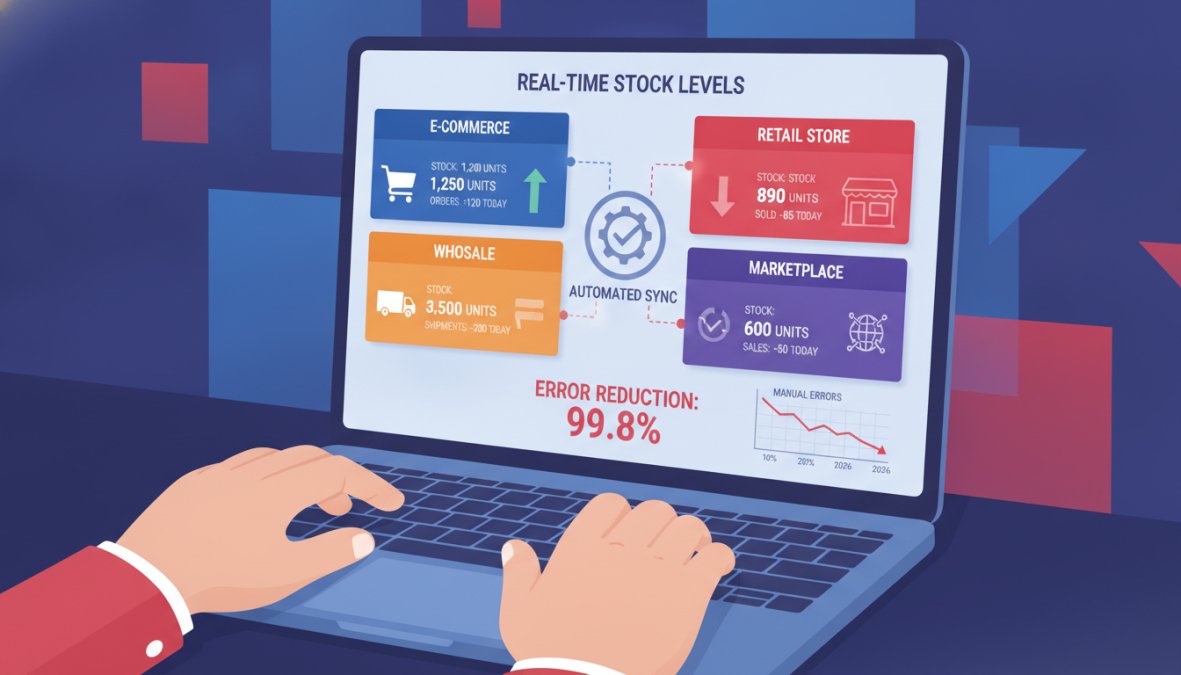
IMAGE: Close-up of hands typing on a laptop keyboard, screen showing a real-time dashboard with stock level numbers updating across multiple sales channel columns, warm desk lamp lighting in a modern office | section:How Automated [Inventory Software Eliminates Manual Errors]
Automated inventory software replaces human data entry with system-to-system data flows that include validation at every step. When a warehouse receives a shipment, the receipt is entered once into the WMS and propagates automatically to the ERP, the central inventory record, and every connected sales channel. Teams that previously spent hours per week on manual stock reconciliation redirect that time to higher-value work, exception handling volume drops, and investigating the rare discrepancy that does occur takes minutes rather than hours.
What to Look for in a Real-Time API Integration Solution
Choosing the right real-time API integration solution shapes your inventory synchronization risk profile for years. Evaluate solutions against these criteria:
Sync architecture: Does the solution use event-driven webhooks or scheduled polling? Event-driven is strongly preferred for high-velocity operations. Polling intervals should be configurable, not fixed.
Platform coverage: Does the solution natively support every channel you sell on today, plus likely future channels? Stitching together multiple partial solutions creates integration seams that are themselves sources of inventory synchronization risks.
Error handling and alerting: How does the solution behave when an API call fails? What visibility do you get into sync errors, and how quickly are you alerted?
Scalability: Can the solution handle your peak order volume without degrading sync performance? Ask specifically about behavior during high-concurrency scenarios.
Reconciliation tools: Does the solution include built-in inventory reconciliation reporting, or do you need to build that layer separately?
Marqetir addresses these requirements directly for European merchants. The platform's real-time inventory sync layer connects Shopify and WooCommerce stores to Amazon, eBay, and other major marketplaces, propagating stock updates automatically to prevent overselling. AI-powered listing transformation and smart pricing features mean inventory accuracy is maintained alongside listing compliance, without manual intervention, built specifically for merchants who need cross-border selling without the overhead of managing multiple disconnected integrations.
Managing inventory synchronization risks at scale requires more than awareness; it requires architecture designed for failure tolerance from the start. Marqetir's real-time inventory sync, AI listing transformation, and automated compliance tools give European multichannel merchants the operational foundation to sell across Amazon, eBay, and beyond without the constant threat of overselling or stock discrepancies. Start your free trial with Marqetir and eliminate inventory sync failures from your operations.
Frequently Asked Questions
What are the most common inventory synchronization risks?
The most common inventory synchronization risks include overselling due to delayed stock updates, stock discrepancies caused by API latency or failures, manual errors during inventory reconciliation, and data inconsistencies between WMS and ERP systems. In multichannel ecommerce, each additional sales channel multiplies these risks because stock levels must update across all platforms simultaneously. Without automated validation and a central database, even a brief sync gap can result in orders for items that are no longer available.
Why do inventory discrepancies occur in multichannel selling?
Inventory discrepancies in multichannel selling typically occur due to API rate limits that delay stock updates, vendor-specific sync limitations on platforms like Amazon or eBay, and the absence of a central database coordinating all inventory nodes. Manual data entry, mismatched SKU management across platforms, and infrequent sync frequency also contribute. When one channel processes a sale faster than others can receive the update, stock mismatches are almost inevitable without buffer stock and automated exception processes in place.
How can I prevent overselling due to inventory sync errors?
To prevent overselling, implement real-time API integration across all sales channels and maintain a central inventory database as your single source of truth. Use inventory buffer strategies, reserving a small safety stock threshold, to absorb sync delays. Set automated validation rules that flag discrepancies before they cause fulfillment failures. Automated inventory software with built-in API failure recovery protocols can also pause listings when sync is interrupted, protecting you from selling stock you cannot fulfill.
What role does automation play in reducing inventory synchronization risks?
Automation is the most effective tool for reducing inventory synchronization risks. Automated inventory software eliminates manual errors, enforces consistent sync frequency, and applies real-time API integration to push stock level changes across all channels simultaneously. It also enables order orchestration, automated reconciliation, and exception processes that alert teams when data consistency breaks down. Without automation, scaling to multiple marketplaces makes it practically impossible to maintain accurate inventory visibility, increasing the risk of overselling and customer dissatisfaction.
How does poor inventory synchronization affect ecommerce sales and operations?
Poor inventory synchronization directly causes overselling, which leads to order cancellations, customer dissatisfaction, and negative marketplace feedback that can damage seller ratings. Operationally, teams spend significant time on manual inventory reconciliation and resolving stock discrepancies instead of focusing on growth. There is also a financial impact: cancelled orders mean lost revenue, potential penalty fees from marketplaces, and increased customer service costs. Over time, recurring sync failures erode customer trust and reduce repeat purchase rates across all channels.
This article was written using GrandRanker
Ready to transform social listening into proactive protection?
Marqetir pairs AI-powered moderation with human oversight so you catch threats before they spread.
Frequently Asked Questions
What are the most common inventory synchronization risks?
The most common inventory synchronization risks include overselling due to delayed stock updates, stock discrepancies caused by API latency or failures, manual errors during inventory reconciliation, and data inconsistencies between WMS and ERP systems. In multichannel ecommerce, each additional sales channel multiplies these risks because stock levels must update across all platforms simultaneously. Without automated validation and a central database, even a brief sync gap can result in orders for items that are no longer available.
Why do inventory discrepancies occur in multichannel selling?
Inventory discrepancies in multichannel selling typically occur due to API rate limits that delay stock updates, vendor-specific sync limitations on platforms like Amazon or eBay, and the absence of a central database coordinating all inventory nodes. Manual data entry, mismatched SKU management across platforms, and infrequent sync frequency also contribute. When one channel processes a sale faster than others can receive the update, stock mismatches are almost inevitable without buffer stock and automated exception processes in place.
How can I prevent overselling due to inventory sync errors?
To prevent overselling, implement real-time API integration across all sales channels and maintain a central inventory database as your single source of truth. Use inventory buffer strategies — reserving a small safety stock threshold — to absorb sync delays. Set automated validation rules that flag discrepancies before they cause fulfillment failures. Automated inventory software with built-in API failure recovery protocols can also pause listings when sync is interrupted, protecting you from selling stock you cannot fulfill.
What role does automation play in reducing inventory synchronization risks?
Automation is the most effective tool for reducing inventory synchronization risks. Automated inventory software eliminates manual errors, enforces consistent sync frequency, and applies real-time API integration to push stock level changes across all channels simultaneously. It also enables order orchestration, automated reconciliation, and exception processes that alert teams when data consistency breaks down. Without automation, scaling to multiple marketplaces makes it practically impossible to maintain accurate inventory visibility, increasing the risk of overselling and customer dissatisfaction.
How does poor inventory synchronization affect ecommerce sales and operations?
Poor inventory synchronization directly causes overselling, which leads to order cancellations, customer dissatisfaction, and negative marketplace feedback that can damage seller ratings. Operationally, teams spend significant time on manual inventory reconciliation and resolving stock discrepancies instead of focusing on growth. There is also a financial impact: cancelled orders mean lost revenue, potential penalty fees from marketplaces, and increased customer service costs. Over time, recurring sync failures erode customer trust and reduce repeat purchase rates across all channels.