Quick Summary
| Key Insight | What You Need to Know |
|---|---|
| What Are the 4 | What Are the 4 Types of E-Commerce? A Quick Overview |
| 1. Business-to-Consumer (B2C) | The Most Common E-Commerce Model Pros and Cons of B2C E-Commerce |
| Pros and Cons of | Pros and Cons of B2C E-Commerce |
| 2. B2B E-Commerce Examples | 2. B2B E-Commerce Examples and How the Model Works Pros and Cons of B2B E-Commerce |
| Pros and Cons of | Pros and Cons of B2B E-Commerce |
| 3. C2C E-Commerce Platforms | Peer-to-Peer Selling Explained Pros and Cons of C2C E-Commerce |
Table of Contents
- What Are the 4 Types of E-Commerce? A Quick Overview
- 1. Business-to-Consumer (B2C): The Most Common E-Commerce Model
- 2. B2B E-Commerce Examples and How the Model Works
- 3. C2C E-Commerce Platforms: Peer-to-Peer Selling Explained
- 4. Consumer-to-Business (C2B): Flipping the Traditional Sales Cycle
- D2C E-Commerce Advantages and Other Emerging Models to Know
- Building Your E-Commerce Business Strategy: Choosing the Right Model
- Conclusion
Last Updated: April 25, 2026
What Are the 4 Types of E-Commerce? A Quick Overview
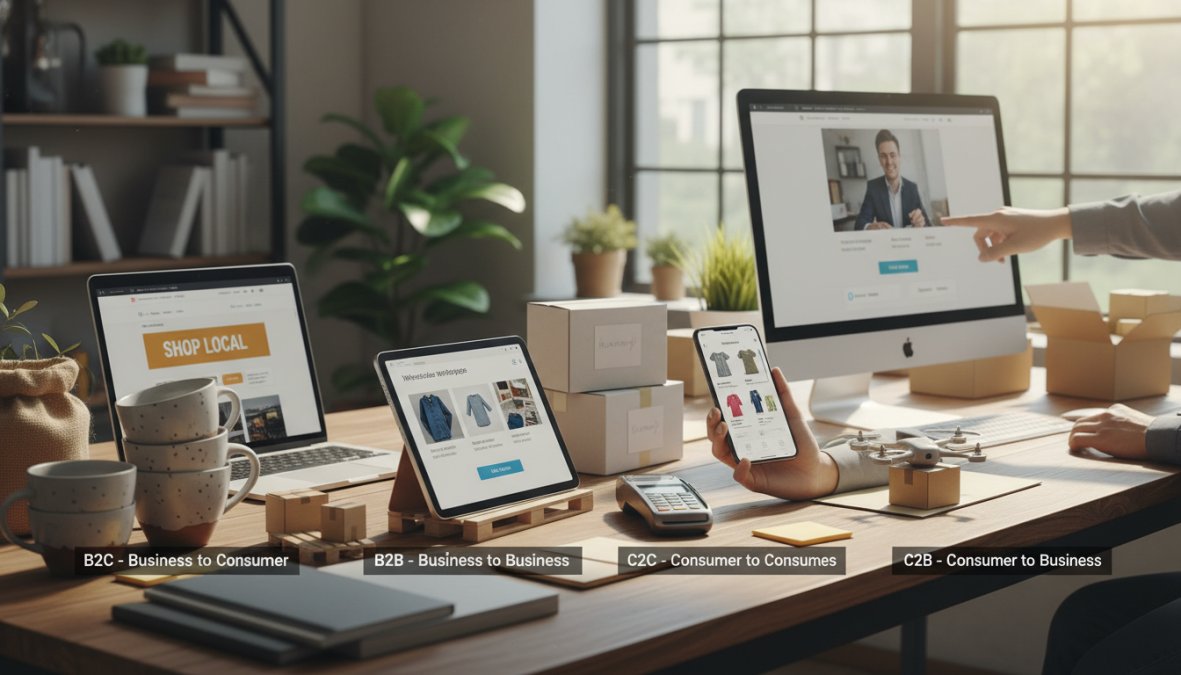
What are the 4 types of e-commerce? The four core models are Business-to-Consumer (B2C), Business-to-Business (B2B), Consumer-to-Consumer (C2C), and Consumer-to-Business (C2B). Every online commercial transaction you encounter fits into one of these categories, whether you're buying running shoes from a retailer, sourcing raw materials from a supplier, or selling freelance services to a brand.
This guide from Marqetir breaks down each model with real examples, honest pros and cons, and practical guidance for choosing the right structure for your business. Below, we'll also cover emerging models like D2C and social commerce that are reshaping how merchants approach online sales in 2026.
Here's what most overviews get wrong: they treat these four types as rigid silos. In practice, many businesses operate across multiple models simultaneously. A manufacturer might run B2B wholesale through an enterprise ecommerce platform while also selling direct-to-consumer through a Shopify storefront. Understanding the distinctions matters because each model demands a different approach to pricing, marketing, logistics, and customer relationships.
The four e-commerce types differ primarily in who is buying and who is selling. B2C involves businesses selling to individual consumers. B2B involves businesses transacting with other businesses. C2C connects individual consumers with each other. C2B flips the traditional sales cycle, with consumers offering products or services to businesses.
| E-Commerce Type | Seller | Buyer | Common Platforms |
|---|---|---|---|
| B2C | Business | Individual consumer | Amazon, Shopify, WooCommerce |
| B2B | Business | Another business | Alibaba, ThomasNet, Shopify Plus |
| C2C | Individual consumer | Individual consumer | eBay, Etsy, Facebook Marketplace |
| C2B | Individual consumer | Business | Upwork, Shutterstock, Fiverr |
1. Business-to-Consumer (B2C): The Most Common E-Commerce Model
B2C e-commerce is the model most people picture when they think about online shopping: a business sells goods and services directly to end consumers through a digital storefront. It's the dominant form of electronic commerce by transaction volume, covering everything from fashion retail to digital streaming subscriptions.
The typical B2C sales cycle is short. A consumer identifies a need, searches online, compares options, and completes a purchase within hours or even minutes. This puts enormous pressure on online retailers to optimize for impulse decisions, clear product presentation, and frictionless checkout. Average order value tends to be lower than B2B, which means B2C merchants must compensate with volume and repeat purchases.
Real-world examples include Amazon, ASOS, and Netflix. These businesses have built their operations around understanding consumer behavior at scale, using digital marketing channels like social media, email, and mobile commerce to drive traffic and convert visitors into buyers.
What most guides miss about B2C is that the real competitive battleground isn't price. It's trust and convenience. Consumers will pay a premium for faster delivery, easier returns, and a seamless mobile experience.
Pros and Cons of B2C E-Commerce
Pros:
- Large addressable market across broad consumer segments
- Shorter sales cycles with faster revenue recognition
- Strong potential for recurring purchases and subscription models
- Digital marketing channels (social media, email, SEO) are mature and well-understood
- Easier to test new products through virtual stores and online sales portals
Cons:
- High customer acquisition costs in competitive retail sections
- Lower average order values compared to B2B
- Consumer loyalty is volatile; switching costs are low
- Returns and customer service demands are significant operational burdens
- Platform dependency (Amazon, Google) creates margin pressure
2. B2B E-Commerce Examples and How the Model Works
The popular assumption is that B2B e-commerce is just B2C with bigger invoices. That's wrong, and the misconception leads businesses to build the wrong infrastructure.
B2B e-commerce is the buying and selling of goods and services between businesses through digital channels. Transactions typically involve producers, wholesalers, and retailers rather than individual end consumers. The sales cycle is longer, involves multiple stakeholders, and often requires custom pricing, bulk order management, and credit terms that standard consumer-facing platforms don't support out of the box.
According to Statista's global B2B ecommerce market overview, B2B electronic commerce consistently outpaces B2C in total transaction value globally. This makes sense: a single B2B contract between a supplier and a retailer can dwarf thousands of individual consumer transactions.
B2B e-commerce examples include Alibaba (connecting manufacturers with wholesalers globally), Grainger (industrial supplies for businesses), and Shopify Plus merchants running wholesale portals alongside their consumer storefronts. Enterprise ecommerce platforms built for B2B handle features like tiered pricing, purchase order workflows, and account-level inventory allocation.
The thing nobody tells you about B2B online business is that the buying decision rarely rests with one person. You're selling to a committee. Your online store needs to support quote requests, approval workflows, and detailed product specifications, not just a "Buy Now" button.
Pros and Cons of B2B E-Commerce
Pros:
- Higher average order values and larger transaction volumes
- Longer customer relationships with stronger retention
- Predictable revenue through contracts and recurring orders
- Less price sensitivity among professional buyers evaluating total value
- Growing adoption of self-serve digital purchasing among business buyers
Cons:
- Complex sales cycles requiring significant relationship investment
- Platform and technology requirements are more demanding and costly
- Customization needs (pricing tiers, account management) require enterprise ecommerce platforms
- Longer payment cycles can strain cash flow
- Onboarding new clients takes more time and resources than B2C
3. C2C E-Commerce Platforms: Peer-to-Peer Selling Explained
Peer-to-peer selling is older than the internet, but digital platforms transformed it into a global market segment. C2C e-commerce connects individual consumers who want to sell goods or services directly to other consumers, with a platform acting as the intermediary infrastructure.
C2C e-commerce platforms make money by charging transaction fees, listing fees, or subscription access to sellers, rather than buying and reselling inventory themselves. eBay is the original model. Etsy carved out a niche for handmade and vintage goods. Facebook Marketplace brought C2C selling into social media. Vinted and Depop focus on secondhand fashion. Each platform serves a distinct market segment while sharing the same fundamental C2C structure.
The appeal for sellers is low barrier to entry. Anyone with a product and a smartphone can start selling. For buyers, C2C platforms offer access to unique items, competitive prices, and the ability to monetize things they no longer need.
A common mistake among first-time C2C sellers is underpricing to compete on volume. The better approach is to focus on presentation quality: clear photos, detailed descriptions, and responsive communication. These factors drive conversion more reliably than a race to the bottom on price.
Pros and Cons of C2C E-Commerce
Pros:
- Minimal startup costs for individual sellers
- Access to established buyer communities on major platforms
- Ideal for monetizing secondhand goods, handmade items, or niche products
- Platforms handle payment processing and basic dispute resolution
- No need to build or maintain an independent online store
Cons:
- Platform fees reduce margins significantly on lower-priced items
- Sellers have limited control over platform rules and algorithm changes
- Trust and fraud risks are higher than in traditional retail
- Scaling beyond a side income requires significant time investment
- No direct access to buyer data for email or digital marketing follow-up
4. Consumer-to-Business (C2B): Flipping the Traditional Sales Cycle
Most e-commerce models have businesses at the center of supply. C2B inverts that entirely.
Consumer-to-Business e-commerce is a model where individual consumers create value that businesses purchase. The consumer is the supplier; the business is the client. This model has grown significantly with the rise of the creator economy, freelance platforms, and user-generated content marketplaces.
According to Shopify's commerce trends research, the creator and freelance economy represents one of the fastest-growing segments of digital commerce. Platforms like Upwork and Fiverr are pure C2B plays: individual professionals offer services that businesses buy. Stock photography sites like Shutterstock operate on C2B logic: photographers upload images that brands license for commercial use.
C2B also shows up in influencer marketing, where individual content creators with established audiences charge businesses for sponsored posts and product placements. The consumer becomes the seller; the brand becomes the buyer.
What stands out about C2B is how dramatically it shifts pricing power. In traditional retail, businesses set prices and consumers accept or reject them. In C2B, the individual often sets their own rates, especially in high-demand creative or technical niches.
Pros and Cons of C2B E-Commerce
Pros:
- Individuals can monetize skills, content, and audiences without building a traditional business
- Businesses access specialized talent or content on demand without full-time hiring
- Flexible engagement models (per-project, subscription, licensing)
- Low overhead for consumer-side participants
- Aligns well with the growing preference for independent work
Cons:
- Income is often inconsistent and project-dependent for individual sellers
- Businesses face quality variability when sourcing from individual contributors
- Intellectual property and usage rights require careful contract management
- Platforms take significant commissions from transaction value
- Harder to build long-term client relationships at scale
D2C E-Commerce Advantages and Other Emerging Models to Know
The four traditional types of e-commerce describe most of what happens online, but they don't capture everything. Three emerging models are reshaping how businesses and consumers interact on the web.
Direct-to-Consumer (D2C) is technically a subset of B2C, but it deserves its own category. D2C e-commerce advantages center on margin and data. When a brand sells directly through its own online store rather than through retailers or marketplaces, it captures the full retail margin, owns the customer relationship, and collects first-party data. Brands like Gymshark and Allbirds built their initial growth on D2C strategies before expanding into wholesale. The trade-off is that you're responsible for all customer acquisition costs and logistics.
Business-to-Administration (B2A) and Consumer-to-Administration (C2A) cover transactions between businesses or citizens and government entities. Tax filing platforms, business licensing portals, and government procurement systems fall into these categories. They're less visible in commercial discussions but represent significant transaction volume, particularly in European markets.
Social Commerce and Live Commerce
Social commerce is the integration of selling products directly within social media platforms, removing the step of redirecting users to an external online store. Instagram Shopping, TikTok Shop, and Pinterest's product pins are the clearest examples. The friction reduction is significant: a consumer can see a product in a feed and complete a purchase without leaving the app.
Live commerce takes this further. A seller broadcasts a live video, demonstrates products in real time, and viewers purchase during the stream. This model originated in China and has expanded rapidly across Western markets through platforms like TikTok and Amazon Live. Many businesses find that live commerce drives higher conversion rates than static product pages because the real-time demonstration builds trust faster.
For merchants managing multiple channels, the operational complexity of social commerce and live commerce is real. Inventory synchronization across an online store, marketplace listings, and social commerce channels requires automation. This is where tools like Marqetir become critical: real-time inventory sync prevents overselling across channels, while AI-powered listing transformation ensures product data stays consistent whether it's published on Amazon, eBay, or a social commerce integration.
Building Your E-Commerce Business Strategy: Choosing the Right Model
Choosing an e-commerce model isn't a philosophical exercise. It's an operational decision with direct consequences for your technology stack, pricing strategy, and marketing approach.

Start by answering three questions: Who is your buyer? What is your average transaction value? How long is your sales cycle? These three variables will point you toward the right model faster than any framework.
Here's a practical decision guide:
- Choose B2C if you're selling consumer goods or digital services to individuals, your average order value is under $500, and you want to scale through digital marketing and SEO.
- Choose B2B if your products serve business operations, your transactions exceed $1,000, and your buyers require account management, bulk pricing, or purchase order workflows.
- Choose C2C if you're an individual or small operation monetizing inventory without building a full brand infrastructure.
- Choose C2B if you have a specialized skill, creative output, or audience that businesses will pay to access.
- Choose D2C if you're a manufacturer or brand that currently sells through distributors and wants to reclaim margin and customer data.
According to McKinsey's digital commerce insights, businesses that clearly define their primary commerce model before investing in technology see significantly better outcomes than those who try to serve multiple models with a single undifferentiated platform.
A common mistake is choosing a model based on what competitors do rather than what your operational capabilities support. A small team trying to run enterprise B2B e-commerce without the right platform and sales support will struggle regardless of market demand.
For European merchants specifically, cross-border selling adds another layer of complexity. Compliance requirements, currency handling, and marketplace-specific listing rules vary significantly across markets. Marqetir's compliance automation and AI listing transformation address this directly, converting Shopify or WooCommerce product data into marketplace-ready listings across Amazon and eBay with a 99% first-time acceptance rate, which eliminates one of the biggest operational bottlenecks in cross-border e-commerce.
The e-commerce business strategy that works is the one that matches your model to your actual resources, not the one that sounds most ambitious on paper.
As the lines between models blur further in 2026, with brands running B2C and B2B simultaneously and social commerce blurring C2C and B2C, the merchants who win are those who understand the underlying logic of each model rather than just copying a competitor's channel mix. According to Forrester's commerce market research, multichannel merchants who maintain consistent product data across all sales channels see measurably better customer retention than those managing channels in isolation.
The model you choose shapes every downstream decision. Get that foundation right, and the rest becomes significantly easier to execute.
Managing multiple e-commerce models across different channels creates real operational complexity, particularly around inventory accuracy and marketplace compliance. Marqetir solves this for European merchants by automating product listing creation and publishing across Amazon and eBay, with real-time inventory synchronization that eliminates overselling and smart pricing built in. Get started with Marqetir and automate your cross-border selling in minutes with zero listing fees and a 99% first-time acceptance rate.
Frequently Asked Questions
What are the 4 types of e-commerce?
The four core types of e-commerce are Business-to-Consumer (B2C), Business-to-Business (B2B), Consumer-to-Consumer (C2C), and Consumer-to-Business (C2B). Each model describes who is buying and who is selling in an online commercial transaction. B2C is the most common, covering everyday retail purchases. B2B handles high-volume sales between companies. C2C connects individual sellers on platforms like eBay, and C2B lets consumers monetize their skills or content by selling to businesses.
What is the difference between B2B and B2C e-commerce?
B2B (business-to-business) e-commerce involves transactions between companies, such as a wholesaler supplying a retailer, and typically features higher order values, longer sales cycles, and volume-based pricing. B2C (business-to-consumer) e-commerce targets end consumers directly through online stores or virtual malls, with faster purchase decisions and lower average order values. B2B platforms often require enterprise ecommerce features like custom pricing and account management, while B2C focuses on digital marketing, social media, and conversion optimization.
What are examples of C2C e-commerce platforms?
Common C2C e-commerce platforms include eBay, Etsy, Facebook Marketplace, Vinted, and Depop. These platforms act as intermediaries, enabling individual consumers to list and sell goods and services to other consumers. They handle payment processing, dispute resolution, and trust mechanisms like seller ratings. C2C is popular for second-hand goods, handmade items, and niche collectibles. For sellers looking to scale beyond C2C into multichannel selling, tools like Marqetir can help automate listings across major marketplaces.
What are the advantages of D2C e-commerce?
D2C (direct-to-consumer) e-commerce lets producers and manufacturers sell directly to the end consumer, bypassing wholesalers and retailers. Key D2C e-commerce advantages include higher profit margins, full control over branding and customer experience, direct access to customer data, and the ability to build recurring purchase relationships. D2C brands can also respond faster to market feedback. The model works well alongside platforms like Shopify or WooCommerce and pairs naturally with a multichannel e-commerce business strategy.
What is the most common type of e-commerce?
Business-to-Consumer (B2C) is widely considered the most common type of e-commerce. It covers the everyday experience of shopping from an online retailer, whether through brand websites, virtual stores, or large platforms like Amazon. B2C benefits from broad market segmentation opportunities, high transaction volume, and strong support from digital marketing channels including email, social media, and mobile commerce. Most people interact with B2C e-commerce daily without realizing it.
How do I choose the right e-commerce model for my business?
Choosing the right e-commerce model depends on who your customer is (businesses or consumers), what you're selling, and how your supply chain works. Start by identifying your primary buyer: if it's another company, B2B is likely your model; if it's an individual shopper, B2C or D2C fits better. Consider your sales cycle length, average order value, and whether you want to sell on your own online store or through third-party platforms. A clear e-commerce business strategy aligned with your target market is the most reliable starting point.
This article was written using GrandRanker
Ready to transform social listening into proactive protection?
Marqetir pairs AI-powered moderation with human oversight so you catch threats before they spread.
Frequently Asked Questions
What are the 4 types of e-commerce?
The four core types of e-commerce are Business-to-Consumer (B2C), Business-to-Business (B2B), Consumer-to-Consumer (C2C), and Consumer-to-Business (C2B). Each model describes who is buying and who is selling in an online commercial transaction. B2C is the most common, covering everyday retail purchases. B2B handles high-volume sales between companies. C2C connects individual sellers on platforms like eBay, and C2B lets consumers monetize their skills or content by selling to businesses.
What is the difference between B2B and B2C e-commerce?
B2B (business-to-business) e-commerce involves transactions between companies — such as a wholesaler supplying a retailer — and typically features higher order values, longer sales cycles, and volume-based pricing. B2C (business-to-consumer) e-commerce targets end consumers directly through online stores or virtual malls, with faster purchase decisions and lower average order values. B2B platforms often require enterprise ecommerce features like custom pricing and account management, while B2C focuses on digital marketing, social media, and conversion optimization.
What are examples of C2C e-commerce platforms?
Common C2C e-commerce platforms include eBay, Etsy, Facebook Marketplace, Vinted, and Depop. These platforms act as intermediaries, enabling individual consumers to list and sell goods and services to other consumers. They handle payment processing, dispute resolution, and trust mechanisms like seller ratings. C2C is popular for second-hand goods, handmade items, and niche collectibles. For sellers looking to scale beyond C2C into multichannel selling, tools like Marqetir can help automate listings across major marketplaces.
What are the advantages of D2C e-commerce?
D2C (direct-to-consumer) e-commerce lets producers and manufacturers sell directly to the end consumer, bypassing wholesalers and retailers. Key D2C e-commerce advantages include higher profit margins, full control over branding and customer experience, direct access to customer data, and the ability to build recurring purchase relationships. D2C brands can also respond faster to market feedback. The model works well alongside platforms like Shopify or WooCommerce and pairs naturally with a multichannel e-commerce business strategy.
What is the most common type of e-commerce?
Business-to-Consumer (B2C) is widely considered the most common type of e-commerce. It covers the everyday experience of shopping from an online retailer — whether through brand websites, virtual stores, or large platforms like Amazon. B2C benefits from broad market segmentation opportunities, high transaction volume, and strong support from digital marketing channels including email, social media, and mobile commerce. Most people interact with B2C e-commerce daily without realizing it.
How do I choose the right e-commerce model for my business?
Choosing the right e-commerce model depends on who your customer is (businesses or consumers), what you're selling, and how your supply chain works. Start by identifying your primary buyer: if it's another company, B2B is likely your model; if it's an individual shopper, B2C or D2C fits better. Consider your sales cycle length, average order value, and whether you want to sell on your own online store or through third-party platforms. A clear e-commerce business strategy aligned with your target market is the most reliable starting point.